Close and Open for Volume Profile AnalysisThis script adds arrows to where Open and/or Close are.
It is usually better to study seasonal volume with candles off, yet it is worth knowing where the closing price is.
Cari dalam skrip untuk "volume profile"

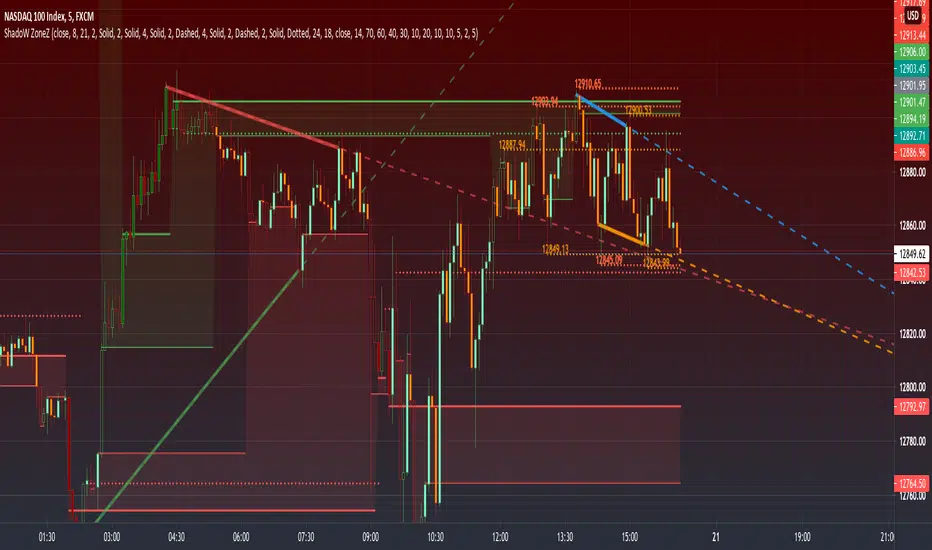
PRIME - ShadoW ZoneZ with RSI LevelsIn This experimental study, we've taken RSI data, Volume Profile, and Trend analysis, combining them into one unique package that will allow a trader to analyze market trend lines and their proposed channels, trend momentum through candle color augmentation similar to "Pulse", and Visible Volume index price levels on chart for the current sequence. Below are explanations of each function within the system.
The Semafor is used to spot future multi-level Supports and Resistance zones.
It is also useful to spot HL or LL or HH or LH zones at different Depth settings.
The red zones are the extreme places where the market has a higher chance of reversing while the green zones have the lowest setting with lower chances of the market reversal
Automatic Trend Lines
The indicator takes in 2 timeframes to detect High and Low values from which to draw the trend lines of each timeframe.
As the values change with price movement, the lines are updated. They are color coded for uptrend and downtrend based on the direction of each individual line. Trend lines can be set up to color with only the default value on the configurations panel.
- Toggle on/off Color Coded
- Change Default, Uptrend, Downtrend color
- Change Line Width
- Change Line Style
- Toggle on/off Line Extensions
- Change Extended Line Width
- Change Extended Line Style
- Toggle On/Off labels for 7 data points of each timeframe
Automatic Trend Sights
This is a neat feature that may help you get a better feel for the direction the current movement is heading towards in correlation with the short or medium length timeframe trends. The sight draws a line from the middle vertical point of the trend coordinates towards the current price. They are toggled off by default but can be enabled in the configurations panel.
- Toggle on/off sight on each timeframe
- Change Width
- Change Line Style
Support & Resistance Levels, the main aim of the study. Level calculations are based on Relative Strength Index ( RSI ) threshold levels of oversold/overbought and bull/bear zones, where all threshold values are customizable through the user dialog box. Background of the levels can be colored optionally.
RSI Weighted Colored Bars and/or Mark Overbought/Oversold Bars , Bar colors can be painted to better emphasis RSI values. Darker colors when the oscillator is in oversold/overbought zones, light colors when oscillator readings are below/above the bull/bear zone respectively, and remain unchanged otherwise. Besides the colors, with “Display RSI Overbought/Oversold Price Bars” option little triangle shapes can be plotted on top or bottom of the bars when RSI is in oversold/overbought zones .
Disclaimer:
Trading success is all about following your trading strategy and the indicators should fit within your trading strategy, and not to be traded upon solely
The script is for informational and educational purposes only. Use of the script does not constitute professional and/or financial advice. You alone have the sole responsibility of evaluating the script output and risks associated with the use of the script. In exchange for using the script, you agree not to hold dgtrd TradingView user liable for any possible claim for damages arising from any decision you make based on use of the script
Mean Deviation Detector - Throw Out All Other IndicatorsI set out this morning to create a script that searches out price moves that went too far too fast relative to historical pricing, given that such situations often result in the most profitable trading opportunities. I came up with the mean deviation detector. This script should be used as a means of judging how far a price is trading, in percent terms, from it's "average trading zone".
This is extremely helpful in a couple scenarios.
First, it can be used to judge a move's volatility relative to it's previous volatility. Put simply, a 5% move in the stock of Coca Cola is a lot more meaningful than a 5% move in the stock of Tesla, and the detector puts moves into historical (visual) perspective.
Second, the indicator can be used in real time as a means of determining when the chances of mean reversion are high or low. Extreme values are unsustainable and often lead to EITHER A.) price mean reversion or B.) time mean reversion. Put simply, prices either went too far and are due to fall back to a historical mean, or they need more time to digest a potentially new pricing zone.
Without getting too deep into volume profile analysis, the MDD can be a simple way of telling that a stock has moved into an "air pocket", where prices will either come back to the previous volume node (price mean reversion) or set up shop in a new, uncharted area (time mean reversion).
An extreme value doesn't always mean a trading opportunity, but it means that something interesting is happening in the stock / instrument.
I use this indicator to help me trade covered calls. Lots of high yielding weekly opportunities are stocks that have moved too far too fast, and I like to use this indicator as a means of either a.) scooping up stocks that have gotten beat up from a historical mean perspective & have likely seen the risk already "beaten" out of them, or to b.) stay away from stocks that have a very high chance of price correcting lower. In situations where I say that the risk has been "beaten" out of something, it doesn't mean that the stock won't continue to fall, it simply means that the degree and acceleration of the fall has peaked and that risk premiums in selling options will / should easily pay for continued losses. In the event that it's a price correction and not a time correction, you also increase your bat rate because you get auto-liquidated at a max profit. It's a really valuable tool in my kit.
You can also feel free to put a Keltner Chanel overlay onto the MDD to filter out noise, identify "extreme" values, and place mean reversion trades if you expect price mean reversion is likely, if you want to use this as the basis of a proper trading strategy. For a high extreme value, you could sell short term OTM call spreads, for example.
The MDD is adaptable to your own trading style & preferences.

Hancock - Volume HeatSimple script that shows the volume profile over a moving period as a heat map. Value area is the green area with the white line as the POC.
Happy trading
Hancock

Initial Balance - (IB)Hello Traders,
--->> Initial Balance (IB) which plays a very important role in Day Trading, that can be used as a referance area <<---
This indicator plots the 1 Hr IB high and low area that can be used as a tool for trading decision.
Will be very helpful to the traders who has idea about Volume Profile trading.
Just a note :
If the IB is narrow compared to the prev day then one can expect a breakout, if IB is extended then the day might be oscillating inside the area only.
nothing fancy :)))
cheers,
enjoy
Sanjay Ramanathan


Initial Balance Trader NXiIB (Initial Balance) can be trade at IBL or IBH. My setup based on 30min IB zone. This strategy can be trade in GOLD, SP500 or Currencies etc. Can be combine with VP (Volume profile)
Visit us for more:
www.traderxi.com

VIP ALERTS - Risk Management SuiteVIP ALERTS - Risk Management Suite
1) Volume Profile
2) Key Levels
3) Trend + MA Suite
4) Buy/Sell Alert
5) Scalping Alert

DFH - Zenith Resonance - Market Phase Intelligence (ZMR)DFH - Zenith Resonance - Market Phase Intelligence (ZMR) is an institutional-grade analytical framework designed to identify capital-driven market behavior through multi-factor, multi-timeframe analysis.
Unlike traditional indicators that rely on single oscillators or isolated thresholds, ZMR integrates multiple signal families—including momentum, structure, volatility, and market participation—across various timeframes to help traders identify:
• Institutional accumulation phases
• Impulse expansion (momentum surges)
• Climax and exhaustion patterns
• Distribution and breakdown phases
ZMR is not a buy/sell signal generator.
It is a market phase intelligence framework.
Core Philosophy: Structure vs. Energy
Resonance, Not Single Signals
ZMR analyzes market behavior across two complementary dimensions:
Structure (Context):
• Defines equilibrium zones, trend control, and key decision levels
• Slower-moving components with higher reliability
• Answers: "Where are we in the bigger picture?"
Energy (Impulse):
• Detects acceleration, imbalance, and capital deployment
• Faster-moving components for timing precision
• Answers: "When is intent turning into action?"
Structure tells you WHERE.
Energy tells you WHEN.
When both dimensions align—creating resonance—market noise decreases and analytical clarity increases.
Key Features
✓ Multi-timeframe phase detection
✓ Adaptive signal generation across market conditions
✓ Visual phase identification through color-coded backgrounds
✓ Institutional accumulation and distribution detection
ZMR works best when combined with price action analysis, volume profile, and proper risk management.
Educational Use
This indicator is designed for educational and analytical purposes. It helps traders:
• Understand multi-timeframe market structure
• Recognize institutional behavior patterns
• Improve timing precision through resonance concepts
• Develop context-aware trading strategies
Access & Support
This is an invite-only indicator.
To request access or learn more about ZMR methodology:
• Send a direct message through TradingView
Trial periods and educational resources are available for qualified traders.
Risk Disclaimer
IMPORTANT:
• ZMR does NOT provide financial advice or guaranteed trading signals
• This tool provides market phase intelligence to support your independent decision-making
• Past performance and backtested results do not guarantee future performance
• Trading involves substantial risk of loss and is not suitable for all investors
• You are solely responsible for your trading decisions and risk management
• Always conduct your own analysis and consult with qualified financial professionals before making investment decisions
• No indicator can predict market movements with certainty
By using this indicator, you acknowledge that all trading decisions and their consequences are your own responsibility.

Daily 50 per cent (High Low Dinamic)📊 Daily 50% Mid – Dynamic High/Low
🔎 Description
The Daily 50% Mid is a clean and objective indicator that plots the daily equilibrium level, calculated as 50% of the distance between the daily high and daily low.
Unlike static levels, this indicator is fully dynamic: as new daily highs or lows are formed, the 50% level is recalculated in real time throughout the trading session.
⚙️ How it works
Automatically detects:
📈 Daily High
📉 Daily Low
Calculates the daily midpoint:
(
𝐷
𝑎
𝑖
𝑙
𝑦
𝐻
𝑖
𝑔
ℎ
+
𝐷
𝑎
𝑖
𝑙
𝑦
𝐿
𝑜
𝑤
)
/
2
(Daily High+Daily Low)/2
Continuously updates the levels while the trading day is in progress.
📐 What the indicator plots
🔴 Daily High line
🟢 Daily Low line
🟡 50% of the Daily Range (Daily Mid) line
🎯 Trading applications
The 50% daily midpoint is widely used as:
A daily balance / equilibrium zone
A pullback level in trending days
A rejection area in range-bound markets
A confluence level with:
VWAP
Daily open
Volume Profile
Price structure
⏱️ Recommended timeframes
Designed for intraday charts
(1m, 5m, 15m, etc.)
Ideal for day trading
Not recommended for daily charts
🧠 Notes
Works on any asset (indices, stocks, forex, crypto)
Automatically resets at the start of each trading day
No future repainting

USDJPY Timing Composite (5-Component)Overview
A sophisticated multi-component oscillator designed specifically for intraday USDJPY trading. This indicator combines five key market drivers to provide high-probability timing signals by isolating true USD strength and JPY weakness from noise.
Components & Methodology
The indicator uses z-score normalization (default 20-period lookback) to make five distinct market signals comparable and combines them into a single composite reading:
Primary USD Strength Signals (60%):
-EURUSD (30%) - Inverted EUR/USD measures USD strength against the Euro
USDCHF (30%) - USD strength against the Swiss Franc
Yield Differential (25%):
US02Y (25%) - 2-Year Treasury yield captures Fed policy expectations and carry trade dynamics
JPY Weakness Confirmation (15%):
CHFJPY (7.5%) - CHF/JPY cross isolates JPY-specific weakness
EURJPY (7.5%) - EUR/JPY cross provides additional JPY context
Key Features
✅ Multi-Source Validation - Separates real USD strength from currency-specific noise
✅ JPY Context Filter - Confirms whether moves are driven by USD strength, JPY weakness, or both
✅ Alignment Indicator - Visual dots show when 4+ components agree (high-confidence setups)
✅ Mean-Reversion Zones - Overbought/oversold thresholds at ±1.5 standard deviations
✅ Clean Visualization - Candle-based display (no wicks) for easy interpretation
How to Use
Basic Signals:
Green candles = Bullish USDJPY pressure (USD strengthening / JPY weakening)
Red candles = Bearish USDJPY pressure (USD weakening / JPY strengthening)
Above +1.5 = Overbought zone → look for mean-reversion shorts
Below -1.5 = Oversold zone → look for mean-reversion longs
High-Confidence Setups (Alignment Dots):
Lime dot at top = 4+ components bullish → strong long bias
Magenta dot at bottom = 4+ components bearish → strong short bias
No dots = Mixed signals → reduce position size or wait for clarity
Divergence Trading:
USDJPY makes new high but composite doesn't confirm → potential reversal down
USDJPY makes new low but composite doesn't confirm → potential reversal up
Best Practices
Timeframes: 5-minute to 15-minute charts for intraday trading
Session Focus: London and New York overlap (peak liquidity)
Pair With: Support/resistance levels, volume profile, or session highs/lows
Risk Management: Use alignment indicator to size positions (larger size when dots present)
Weight Adjustments:
Fed data days (CPI, NFP, FOMC): Increase US02Y weight to 30-35%
Pure FX sessions: Increase -EURUSD/USDCHF weights to 35% each
Risk-off events: Monitor CHFJPY/EURJPY for safe-haven JPY flows
Technical Details
Calculation Method: Z-score normalization with configurable lookback period
Default Weights: -EURUSD 30% | USDCHF 30% | US02Y 25% | CHFJPY 7.5% | EURJPY 7.5%
Extreme Threshold: ±1.5 standard deviations (adjustable)
Alignment Trigger: 4 out of 5 components in agreement
Customizable Parameters:
Z-score lookback period (default: 20)
Individual component weights
Extreme threshold levels
Alignment indicator on/off
Advantages Over Simple Indicators
Unlike single-pair or DXY-based indicators, this composite:
Filters false signals - USD strength confirmed by two independent FX pairs
Identifies source of moves - Separates USD dynamics from JPY-specific flows
Reduces noise - JPY crosses prevent misreading EUR/CHF weakness as USD strength
Adapts to regimes - Adjustable weights for different market conditions
Suggested Complementary Analysis
Price action at key technical levels
Session opening ranges
Economic calendar (especially Fed events)
Correlation with US equity markets during risk-off periods
Intermarket analysis with JGB yields for JPY policy context
Disclaimer
This indicator is a technical analysis tool and does not guarantee profitable trades. Always use proper risk management, consider fundamental factors, and backtest any strategy before live trading. Past performance does not indicate future results.

Institutional Top-Bottom by Herman Sangivera (Papua)Institutional Top-Bottom + Volume Profile by Herman Sangivera ( Papua )
📈 Component Description
Orange Line (POC - Point of Control): This represents the "Fair Value." Institutions view prices far above this line as "Expensive" (Premium) and prices below as "Cheap" (Discount).
Green/Red Boxes (Order Blocks): These are footprints left by big banks. A Green Box is a demand zone where institutional buying occurred, and a Red Box is a supply zone where institutional selling happened.
Institutional Labels: These appear when the RSI Divergence confirms that price momentum is fading, signaling a high-probability reversal (Top or Bottom).
🚀 Trading Strategy Guide
1. The High-Probability Buy Setup (Bottom)
Look for a "Confluence" of these three factors:
Location: Price is trading below the Orange POC line (Discount zone).
The Zone: Price enters or touches a Green Order Block.
The Signal: The "INSTITUTIONAL BUY" label appears.
Entry: Enter Buy at the close of the candle with the label.
Stop Loss: Place it just below the Green Order Block.
Take Profit: Target the Orange POC line or the nearest Red Order Block.
2. The High-Probability Sell Setup (Top)
Look for a "Confluence" of these three factors:
Location: Price is trading above the Orange POC line (Premium zone).
The Zone: Price enters or touches a Red Order Block.
The Signal: The "INSTITUTIONAL SELL" label appears.
Entry: Enter Sell at the close of the candle with the label.
Stop Loss: Place it just above the Red Order Block.
Take Profit: Target the Orange POC line or the nearest Green Order Block.
💡 Pro Tips for Accuracy
Timeframes: For the best results, use 15m for Scalping, and 1H or 4H for Day/Swing Trading.
Wait for the Candle Close: Labels are based on Pivot points. Always wait for the current candle to close to ensure the signal is locked and won't "repaint."
Avoid Flat Markets: This indicator works best when there is volatility. Avoid using it during "choppy" or sideways markets with very low volume.

Asian Liquidity Sweep + NY Reversal [NY Only]Asian Liquidity Sweep + NY Reversal
Concept
Asia builds a tight range → liquidity pool
London / early NY raids that liquidity (stop hunt)
New York delivers the real move in the opposite direction
Sessions utc+3
Asia range: 04:00 – 10:00
Liquidity sweep: London open → pre-NY (≈10:00–14:00)
Execution window: NY Kill Zone 15:00 – 18:00
Step-by-Step Model
Define Asia Range
Mark:
Asia High
Asia Low
Liquidity Sweep (Stop Hunt)
Price must do ONE of the following:
Sweep above Asia High → bullish liquidity taken
Sweep below Asia Low → bearish liquidity taken
NY Reversal Confirmation (Key Part)
Wait for NY Kill Zone and look for:
Strong rejection candle
Displacement / impulsive move back inside range
Optional: small internal structure break on lower TF
Entry Rules (High Probability)
🔻 If Asia High is swept:
Bias: SELL
Entry:
After NY rejection
On pullback to:
Discount zone / FVG
OR Asia High retest
SL: Above sweep high
TP:
Asia Low (TP1)
NY session low / next HTF liquidity (TP2)
If Asia Low is swept:
Bias: BUY
Entry:
NY rejection + displacement
Pullback to imbalance / Asia Low
SL: Below sweep low
TP:
Asia High
Daily high / premium liquidity
arrows/labels-will show when to buy or sell
signal-once per day
Use volume profile (max) for confirmation of entry point
Lets win together

Smart Money Zones [SMZ] - Automatic Supply & Demand DetectionSmart Money Zones automatically detects and draws institutional supply and demand levels on any timeframe, any ticker.
HOW IT WORKS
The indicator identifies "impulse moves" — strong directional candles that indicate institutional buying or selling. It then marks the consolidation area (base) before the impulse as a key zone where price is likely to react on a retest. Data sources for 'moves' are dark pool block trades and tick data.
• Demand Zones (Green): Areas where buying pressure drove price up sharply. Expect support on retest.
• Supply Zones (Red): Areas where selling pressure drove price down sharply. Expect resistance on retest.
• Confluence Zones (Orange): Where supply meets demand — high-probability reaction areas.
FEATURES
✓ Works on any timeframe (1m to Monthly)
✓ Works on any market (Stocks, Crypto, Forex, Futures)
✓ Auto-merges overlapping zones into single clean levels
✓ Zone strength indicator (thicker lines = more confluence)
✓ Fresh/Tested/Broken status tracking
✓ Configurable alerts for zone entries and breaks
✓ Clean, non-cluttered display
ZONE STATUS
• Fresh: Zone has never been tested — highest probability
• Tested: Price touched the zone but held — still valid
• Broken: Price closed through the zone — invalidated (shown as dotted line)
SETTINGS GUIDE
• ATR Multiplier: Higher = fewer but stronger zones (default 1.5)
• Merge Threshold: Higher = more aggressive zone merging (default 0.3)
• Max Active Zones: Limit displayed zones to reduce clutter
BEST PRACTICES
1. Look for confluence zones (orange) for highest probability trades
2. Fresh zones have higher success rates than tested zones
3. Use higher timeframe zones for stronger levels
4. Combine with your existing strategy for entries
Works great alongside order flow, volume profile, or price action strategies.
```
---
### Features
| Feature | Description |
|---------|-------------|
| Auto-Detection | Finds supply/demand zones without manual drawing |
| Smart Merging | Combines nearby zones into single levels |
| Confluence Zones | Highlights where supply meets demand |
| Multi-Timeframe | Works on any timeframe from 1m to Monthly |
| Universal | Stocks, Crypto, Forex, Futures, Indices |
| Zone Strength | Thicker lines indicate stronger confluence |
| Status Tracking | Fresh → Tested → Broken lifecycle |
| Alerts | Get notified on zone entries and breaks |
---
### Settings
| Setting | Default | Description |
|---------|---------|-------------|
| ATR Period | 14 | Period for volatility calculation |
| ATR Multiplier | 1.5 | Impulse detection sensitivity (higher = fewer zones) |
| Merge Threshold | 0.3 | Zone merging distance in ATR units |
| Max Active Zones | 15 | Maximum zones per type (demand/supply) |
| Show Labels | On | Display zone type labels |
| Show Broken Zones | Off | Keep or hide invalidated zones |
| Show Strength | On | Thicker lines for stronger zones |
---
### How It Works
1. **Impulse Detection**: Identifies candles with body size > ATR × multiplier
2. **Base Finding**: Looks back to find consolidation candles before the impulse
3. **Zone Creation**: Draws horizontal line at the key level (top of demand, bottom of supply)
4. **Merging**: Combines zones within the merge threshold distance
5. **Status Tracking**: Updates zone status as price interacts with levels
---
### Keywords
`supply demand` `support resistance` `smart money` `institutional levels` `order blocks` `liquidity zones` `automatic zones` `key levels` `reversal zones` `price action`

the best script out for the painThis script gives you volume profile, fibanocci, trading signals, and more. highlighting value areas and giving you multiple timeframe trend directions. this indicator is the best one i have made so far

Daily Opens (Today/Yesterday/Prev Week)Market open markers for Volume profile traders, Marks Current Day open, Previous Day open, Previous Week open.

AI Smart Signal (MASTER)# User Guide: AI Smart Signal (MASTER)
**The Ultimate All-In-One Trading System**
This comprehensive indicator combines the power of trend following, momentum analysis, and market structure into a single, intelligent tool. It is designed to act as your "Co-Pilot" in the market, providing clear signals and filtering out noise.
---
## 1. Visual Overview
### The Quantum Dots (Wave)
The core of the system is the **Smoothed Heiken Ashi** ribbon, displayed as dynamic dots by default.
- **Green Dots**: Bullish Trend (Look for BUY).
- **Red Dots**: Bearish Trend (Look for SELL).
- **Dot Size**:
- *Small*: Weak market / Ranging.
- *Medium*: Strong Trend.
- *Large*: **HIGH MOMENTUM** (Powerful Move).
### The Instruction Overlay
A dashboard on the chart provides real-time guidance:
- **TREND**: Shows if the market is currently Up or Down.
- **MOMENTUM**: Analyzes the strength of the move (Weak/Strong/Power).
- **ACTION**: Suggests to "HOLD", "BiUY", "SELL", or "WAIT".
---
## 2. Key Features
### A. Signal Strategy
You can choose your preferred entry signal logic in the settings:
1. **AI Smart Signal (Default)**: Uses a SuperTrend-based adaptive algorithm.
2. **Heiken Ashi Reversal**: Signals when the Quantum Wave changes color.
3. **Market Structure**: Signals on Higher Highs (HH) and Lower Lows (LL).
4. **EMA Crossover**: Signals when Fast EMA crosses Slow EMA.
### B. Smart Filters
- **Sideways Filter**: Automatically hides signals when the ADX (trend strength) is low (< 15), preventing losses during choppy markets.
- **Auto Timeframe**: The indicator automatically adjusts its sensitivity based on the chart timeframe (e.g., faster settings for 1-minute, stable settings for Daily).
### C. Additional Tools (Toggle ON/OFF)
- **Demand & Supply Zones**: Auto-draws support and resistance rectangles.
- **Market Structure**: Labels Highs and Lows (HH, HL, LH, LL).
- **Volume Profile**: Shows value areas on the side of the chart.
- **Turtle Channels**: Donchian Channel breakout levels.
- **Multi-Timeframe**: See trend status of higher timeframes on your current chart.
---
## 3. How to Trade
### Long Setup (BUY)
1. **Trend Check**: The Quantum Dots or Ribbon must be **GREEN**.
2. **Signal**: Wait for a **BUY** label or "Cycle Hijau" confirmation.
3. **Validation**: Ensure the "ACTION" dashboard says "BUY" or "HOLD".
4. **Stop Loss**: Place below the recent Swing Low or Demand Zone.
### Short Setup (SELL)
1. **Trend Check**: The Quantum Dots or Ribbon must be **RED**.
2. **Signal**: Wait for a **SELL** label or "Cycle Merah" confirmation.
3. **Validation**: Ensure the "ACTION" dashboard says "SELL" or "HOLD".
4. **Stop Loss**: Place above the recent Swing High or Supply Zone.
---
## 4. Settings Guide
- **Visual Settings**: Change "Visual Style" from Dots to Candles, Line, or Ribbon.
- **Signal Strategy**: Switch entry logic here.
- **Dashboard**: Toggle the AI Dashboard ON/OFF or change its size.

Trend volume profile 2.0Trend Signal Pro is a technical analysis indicator designed to help traders
identify market trend direction and potential entry points.
The indicator analyzes price behavior using standard candlestick data
and applies trend-filtering logic to reduce false signals during
sideways market conditions.
Signals are generated only when multiple internal conditions align,
making it suitable for intraday and swing trading across different markets.
This indicator does not repaint and should be used as a decision-support tool,
not as a standalone trading system. Proper risk management is advised.

Trend volume profile 2.0 Trend Signal Pro is a technical analysis indicator designed to help traders
identify market trend direction and potential entry points.
The indicator analyzes price behavior using standard candlestick data
and applies trend-filtering logic to reduce false signals during
sideways market conditions.
Signals are generated only when multiple internal conditions align,
making it suitable for intraday and swing trading across different markets.
This indicator does not repaint and should be used as a decision-support tool,
not as a standalone trading system. Proper risk management is advised.

Intraday Dynamic levelsThis indicator automatically draws and manages the most important intraday reference levels for day trading:
Main displayed levels:
- Pre-market High & Low (solid blue lines) — highest/lowest prices during the user-defined pre-market session (default 01:00–09:30 NY time)
- Point of Control (POC) (white dotted line) — approximated by the value of 15-minute
SuperTrend at the regular session open (very popular institutional reference level)
- Dynamic Higher Lows / Lower Highs (red/green solid lines) — the most recent significant swing points that respect a minimum distance between levels
How dynamic swing levels work:
New Higher Low (red) is added only when trend changes to bullish AND the new swing low is sufficiently lower than previous lowest level
New Lower High (green) is added only when trend changes to bearish AND the new swing high is sufficiently higher than previous highest level
Minimum distance between levels is either:fixed value (default 3 points/ticks)
or dynamic = Daily ATR(14) ÷ 10 (recommended — much more adaptive)
Maximum number of dynamic levels per side is user-configurable (default = 2)
Additional features:Uses chart SuperTrend (default 4.2×15) to detect trend changes
All lines extend to the right and are properly cleaned/reset at the beginning of each new regular trading session
Non-repainting higher-timeframe calculations (pre-market SuperTrend + daily ATR)
Best used on:15 sec – 15 min charts - Day trading / scalping sessions
Very clean & lightweight visual tool helping traders quickly see:institutional pre-market structure
current market structure swings (higher lows / lower highs)
key value area (POC)
Perfect companion for orderflow, volume profile, or pure price action intraday strategies.Enjoy your trading!

Hull DMI - MattesHull DMI - Mattes
A Directional Movement Index enhanced with Hull Moving Average smoothing for refined trend detection.
This indicator reimagines the classic Directional Movement Index (DMI) by incorporating Hull Moving Average (HMA) smoothing on high and low prices. It calculates the +DI and -DI components based on changes in these hulled values, then derives the ADX for trend strength. The core plot displays the difference between +DI and -DI, colored to indicate bullish (blue) or bearish (purple) dominance when ADX is rising. Additionally, it overlays colored candles on the price chart to visually represent the prevailing trend direction.
Key Features:
Hull-Smoothed Inputs: Applies HMA to highs and lows before computing directional changes, reducing noise and lag compared to standard DMI.
Customizable Lengths: Adjustable periods for HMA, DI, and ADX smoothing to suit various timeframes and assets.
Trend Visualization: Plots DI difference with dynamic coloring and overlays trend-colored candles for at-a-glance analysis.
Alert Conditions: Built-in alerts for long (bullish) and short (bearish) signals when conditions shift.
How It Differs from Standard DMI/ADX:
Unlike the traditional DMI, which uses raw price changes and true range, this version employs Hull Moving Averages on highs and lows for smoother, more responsive directional calculations. This minimizes whipsaws in choppy markets while preserving sensitivity to genuine trends. The ADX is integrated to filter signals, ensuring color changes and alerts only occur during strengthening trends, setting it apart from basic oscillator-based indicators. Why It's Useful:
Enhanced Trend Identification: The HMA smoothing provides clearer signals in volatile environments, helping traders spot emerging trends earlier.
Visual Clarity: Colored DI plot and candle overlays make it easy to interpret market bias without cluttering the chart.
Versatility: Suitable for stocks, forex, crypto, and more; excels in trend-following strategies or as a filter for other systems.
Risk Management Aid: By focusing on ADX-confirmed moves, it reduces false signals, potentially improving win rates in systematic trading.
This Hull DMI variant offers several practical advantages that can directly improve trading decisions and performance:
Reduced Lag with Smoother Signals: By applying Hull Moving Average smoothing to highs and lows, the indicator responds faster to genuine trend changes than the standard DMI while filtering out much of the noise that causes false signals in ranging or choppy markets. Traders get earlier entries into trending moves without excessive whipsaws.
Built-in Trend Strength Filter: The optional ADX confirmation (enabled by default) ensures bullish signals and blue coloring only activate when trend strength is increasing (ADX rising). This helps traders avoid entering long positions during weakening or sideways trends, focusing capital on higher-probability setups.
Clear Visual Bias at a Glance: The single oscillator line (+DI – -DI) centered on zero, combined with dynamic blue/purple coloring and full candle overlay on the price chart, instantly shows the dominant trend direction. No need to interpret multiple lines—traders can quickly assess market bias across multiple charts or timeframes.
Versatile Across Markets and Styles: Works effectively on stocks, forex, futures, and cryptocurrencies. Trend-following traders can use it standalone for entries/exits, swing traders can use it for bias confirmation, and scalpers/day traders benefit on lower timeframes due to the reduced lag.
Improved Risk Management: By prioritizing ADX-confirmed directional moves, the indicator naturally filters low-conviction setups. This can lead to higher win rates and better risk-reward ratios when used systematically, especially when combined with proper stop-loss placement below/above recent swings.
Easy Integration: Built-in alert conditions and simple long/short logic make it straightforward to incorporate into automated strategies, watchlists, or as a confirming filter alongside other indicators (e.g., moving averages, RSI, volume profile).
Customizable Sensitivity: Separate inputs for Hull length, DI period, and ADX smoothing allow traders to optimize the indicator for specific assets, volatility regimes, or personal trading horizons—making it adaptable rather than one-size-fits-all.
Signals & Interpretation
The oscillator plots the difference between +DI and -DI (positive = bullish dominance, negative = bearish).
Bullish Signal (Long): +DI crosses above -DI, and (if ADX confirmation enabled) ADX is rising — triggers blue coloring, candle overlay, and long alert.
Bearish Signal (Short): -DI crosses above +DI — triggers purple coloring, candle overlay, and short alert.
Zero line acts as neutrality; crossings indicate potential trend shifts.
Best used in trending markets; ADX rising filter helps avoid whipsaws.
// Example Usage in Strategy
strategy("Hull DMI Strategy Example", overlay=true)
if L
strategy.entry("Long", strategy.long)
if S
strategy.entry("Short", strategy.short)
Great Inventions Require great care
Disclaimer: This indicator is provided for educational and informational purposes only and should not be considered as financial advice. Past performance is not indicative of future results. Always backtest thoroughly on your specific assets and timeframes, and consult a qualified financial advisor before making trading decisions. The author assumes no responsibility for any losses incurred from its use.

SMC + VP Pro with POC Confluence [MR.M] V.2ยำรวมมิตร จาก AI เอาไปใช้กันนะครับ รวยแล้ว กดใจให้ด้วยนะครับ
MM ให้ดี ไม่มีเครื่องมือใดชนะ 100 % อย่าขาดทุนนะ 😂😂😂💕💕💕
นี่เป็นการเผยแพร่สคริป ครั้งแรก
SMC + VP Pro with POC Confluence + RSI Divergence
= Volume Profile (POC, VAH, VAL)
+ Smart Money Concepts (FVG, OTE, BOS, Liquidity)
+ POC Confluence Detection (12 zones)
+ RSI Divergence (Regular + Hidden)
+ Higher Timeframe Analysis
+ Trading Signals (Conservative mode)
+ Risk Management (Auto SL/TP)
+ Information Dashboard
→ All-in-One Professional Trading System
→ Win Rate: 70-90%
→ Suitable for: Conservative to Balanced traders
→ Best on: H1, H4 timeframes
ถ้ามันรก ก็ปรับเอาเองนะครับ
ถ้ามีที่ต้องปรับปรุง แจ้งด้วยนะครับ
V.2 ปรับปรุงเพียงเล็กน้อย คือ ปรับ✅ ควรเห็น VAH VAL Label เดียว (ราคาล่าสุด) จากที่ค้างไม่ลบอัตโนมัติ

SMC + VP Pro with POC Confluence [MR.M]ยำรวมมิตร จาก AI เอาไปใช้กันนะครับ รวยแล้ว กดใจให้ด้วยนะครับ
MM ให้ดี ไม่มีเครื่องมือใดชนะ 100 % อย่าขาดทุนนะ 😂😂😂💕💕💕
นี่เป็นการเผยแพร่สคริป ครั้งแรก
SMC + VP Pro with POC Confluence + RSI Divergence
= Volume Profile (POC, VAH, VAL)
+ Smart Money Concepts (FVG, OTE, BOS, Liquidity)
+ POC Confluence Detection (12 zones)
+ RSI Divergence (Regular + Hidden)
+ Higher Timeframe Analysis
+ Trading Signals (Conservative mode)
+ Risk Management (Auto SL/TP)
+ Information Dashboard
→ All-in-One Professional Trading System
→ Win Rate: 70-90%
→ Suitable for: Conservative to Balanced traders
→ Best on: H1, H4 timeframes
ถ้ามันรก ก็ปรับเอาเองนะครับ
ถ้ามีที่ต้องปรับปรุง แจ้งด้วยนะครับ
